
IBC 2026: What media tech vendors need to know

As the industry prepares for IBC 2026 in Amsterdam, media tech vendors face a complex and rapidly changing landscape. Under pressure from a consolidating market and shifting buyer priorities, navigating the show floor requires a clear understanding of what customers truly value. Based on our latest analysis, here is what vendors need to know to succeed in this challenging environment.
The reality of market consolidation
The overarching trend shaping the industry is consolidation, which is a natural response to declining markets. Media giants like Netflix and YouTube increasingly dominate, and they are highly likely to build their technology in-house. Consequently, broadcasters and distributors are seeking scale in both audiences and infrastructure, leading to a wave of high-profile mergers, such as Paramount with Warner Bros, and Fox with Roku. For vendors, this consolidation means a shrinking pool of buyers who are aggressively looking to reduce costs by cutting the number of suppliers and streamlining operations.
Monetisation is the top priority
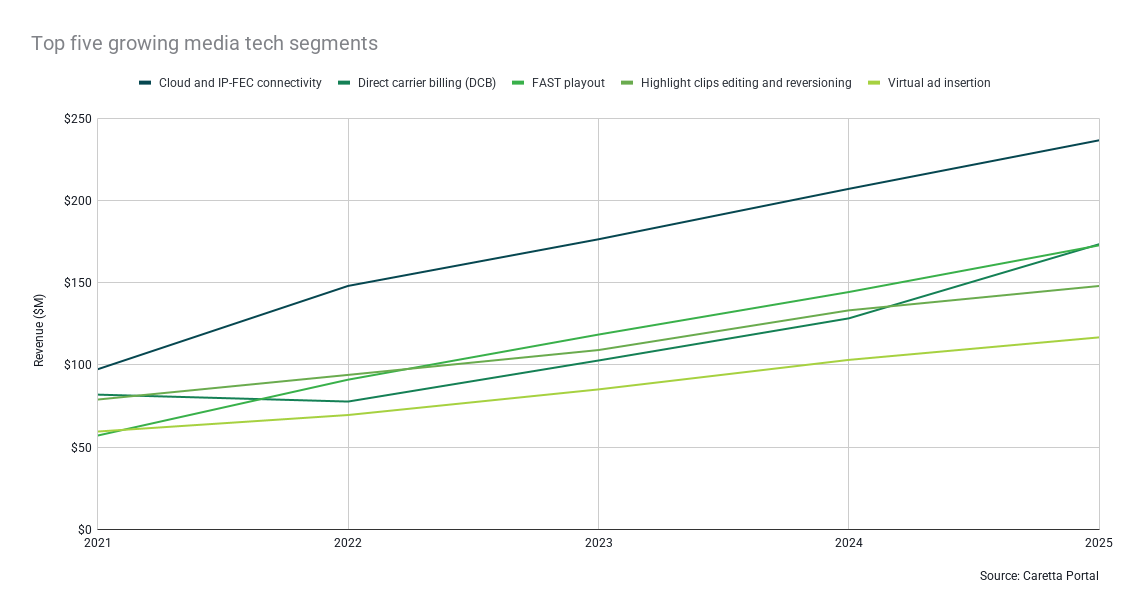
In this economic climate, buyers are heavily prioritising technology that directly drives revenue generation. If a solution does not demonstrably improve the top line, it will be a difficult sell. High-growth areas reflect this laser focus on monetisation:
- FAST playout: spending on FAST (free ad-supported streaming TV) playout grew faster than any other segment between 2021 and 2025, opening new CTV opportunities.
- Direct carrier billing (DCB): growing at a 20.6% CAGR, fueled by the need for bundling and billing via telcos to boost subscribers.
- Virtual ad insertion: sports streaming services are adopting this (18.4% CAGR) to replace static sponsorships.
- Cloud and IP-FEC connectivity: expanding at a 25% CAGR as distribution shifts away from traditional satellite and fibre.
Conversely, legacy distribution technologies like cloud DVR, conditional access systems, set-top box middleware, and traditional camera hardware accessories are experiencing double-digit declines.
The rise of agentic AI
While artificial intelligence is a major talking point, the industry is transitioning from simple chatbots to agentic AI. This technology can coordinate and manage complex, multi-stage workflows (such as metadata extraction, content reversioning, and automated QA) reducing the need for human oversight over time. However, vendors should be realistic: we are still in the early stages of adoption. At IBC 2026, expect to see more demonstrations than actual deployments. Vendors who can showcase practical, automated efficiencies rather than vague promises will stand out.
A market of divergent growth
Despite the market's stagnation, 61% of vendors grew their revenue over 2024 and 2025. These are predominantly cloud-native or software-native businesses focused on streaming and IP-based workflows. Meanwhile, the 39% experiencing declines are those tied to legacy broadcast hardware.
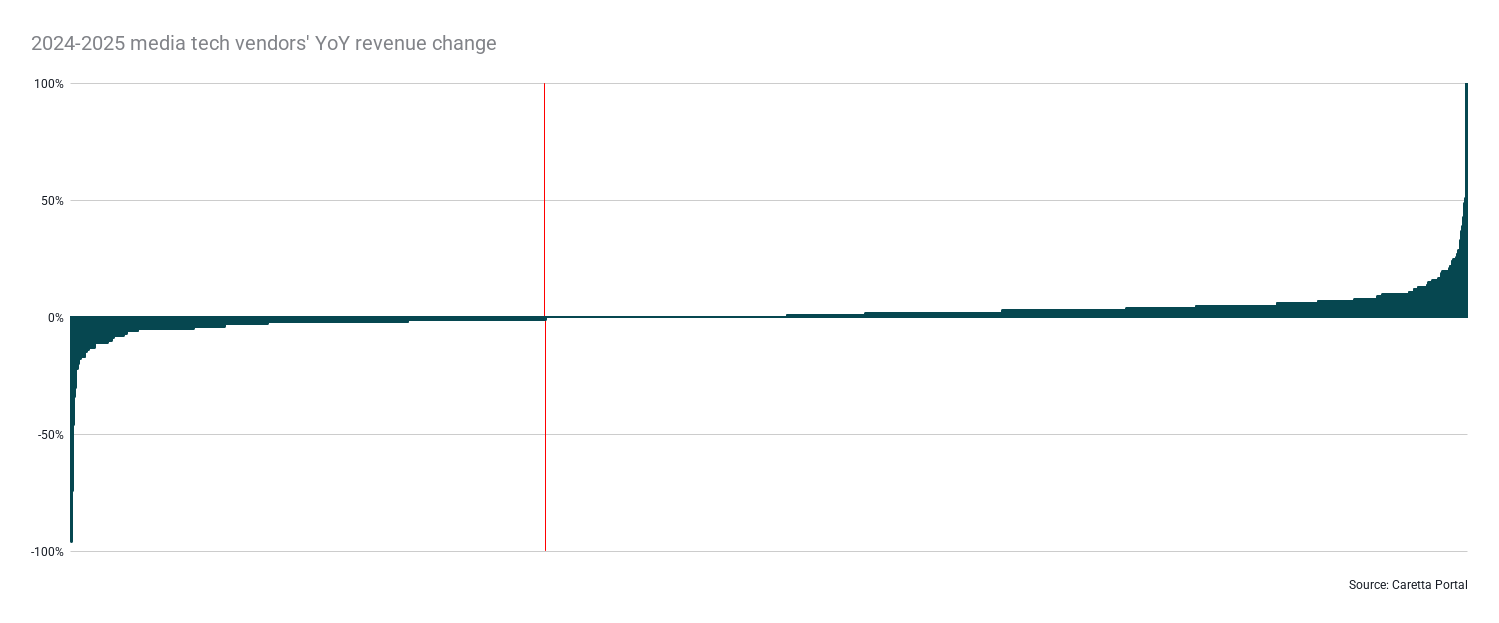
Ultimately, the vendors who will thrive are those helping buyers control costs through managed services and automation, while actively delivering technologies that expand monetisation and streaming capabilities.
For more information on media tech insights and data, contact us at info@carettaresearch.com.
Blog post tags
Blog posts
Read more
October 20, 2026

October 13, 2026
September 25, 2026
