
How the 2026 World Cup’s record revenue masks a structural market contraction
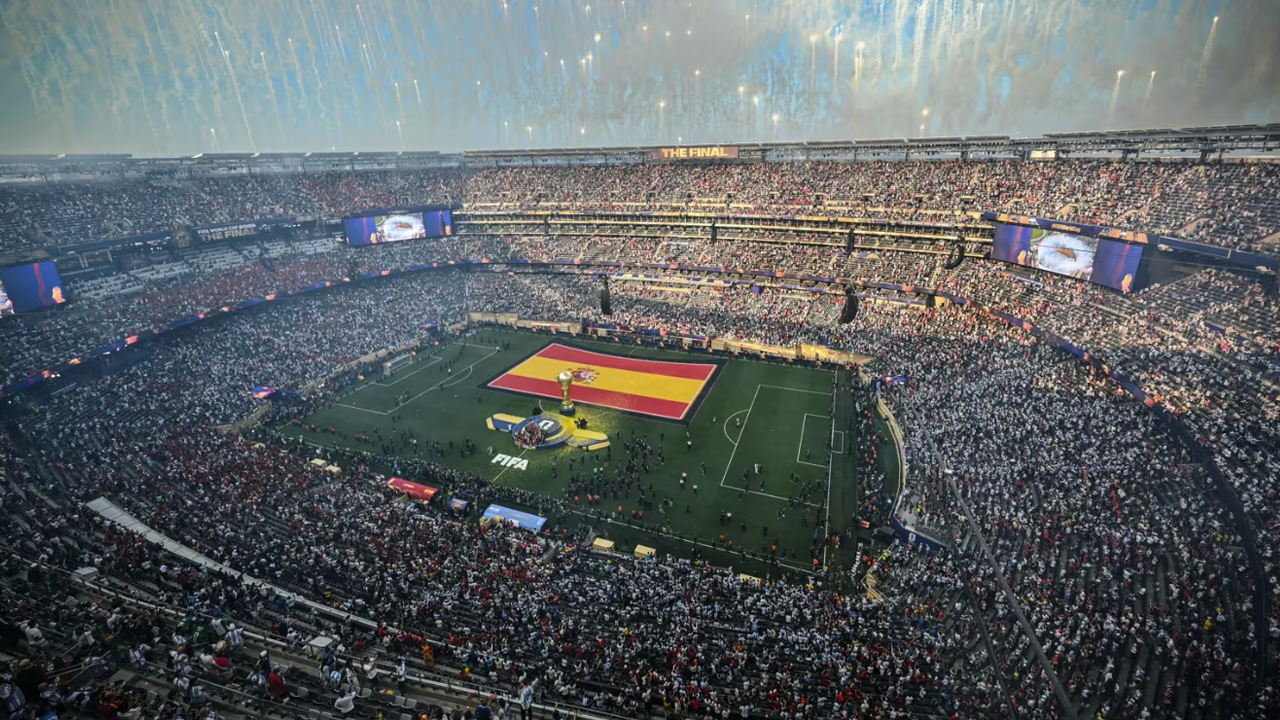
The 2026 FIFA World Cup is, on paper, an unparalleled financial success. Total tournament revenue hit a record-breaking $8.9B, a 54% increase over the 2022 Qatar tournament. However, beneath this top-line success lies a more fragile structural reality. This financial windfall is not a sign of a booming traditional broadcast market, but rather a masterclass in volume scaling.
For industry stakeholders, the tournament marks a definitive turning point: the era of monolithic domestic media rights has likely peaked, making way for a fragmented, hybrid AI-driven and creator-led ecosystem.
Macro performance: the volume vs. value dichotomy
The primary driver for the jump to $8.9B was FIFA’s expansion of the tournament from 32 to 48 teams. This move increased match inventory by 47%, taking the total count from 64 matches in 2022 to 104 matches in 2026.
- Financial drivers: while matchday revenue grew by 220% and commercial revenue rose by 18% ($300M), sports media rights struggled to keep pace.
- The rights value gap: media rights revenue grew by 32% ($1B). Because this growth failed to match the 47% increase in match inventory, the actual value per game dropped by 19%.
Broadcasters are paying higher total fees, but they are receiving less scarcity and, consequently, lower value per minute of live content.
The regional breakdown: time zone penalties and audience volatility
The North American time zone grid created commercial friction for international markets, with the total volume of global broadcast deals dropping by 11% (from 495 in 2022 to 443 in 2026).
- Asia and Europe: prime audiences faced late-night kickoffs, leading to collapsing competitive bidding. In Asia, total broadcast deals fell by 21%. Most notably, the deal with China’s CCTV plummeted from $250M to $60M.
- Latin America: this region thrived due to aligned time zones. Total broadcast deals rose by 18%, supported by a collaborative approach where regional networks and streaming platforms shared financial risk through a 22% increase in multi-territory partnerships.
Empirical evidence: live round-of-32 European audience data
Data from the round-of-32 stage confirms that linear TV suffers when matches air in "dead zones," while digital platforms serve as essential buffers.
- The linear deficit: in France, when matches were moved to late-night slots (such as the 11:00 PM kickoff against Iraq), linear viewership for M6 collapsed by 65%, falling to 4.9 million when it compared with France vs Senegal in 9:00 PM which had 14M viewers.
- The streaming buffer: digital platforms consistently mitigated linear losses.
- UK: England’s semi-final against Argentina became the most-watched UK broadcast of 2026, reaching a peak audience of 24M viewers across BBC One and BBC iPlayer (averaging 22M viewers, an 85% TV share). Simultaneously, the fixture generated 12.6M live and on-demand stream requests across BBC iPlayer and BBC Sport digital platforms, driven by live mobile and second-screen viewing during match time. Additionally, 192,000 second-screen 3D sessions were logged during the game alone (4.6M uses across the tournament), demonstrating significant adoption of interactive digital extensions.
- Netherlands: Despite a 3:00 AM CET kickoff heavily suppressing NOS linear TV averages (capping at 1.9M viewers), the NOS app recorded 1.5M digital stream requests, illustrating how digital platforms cushion the blow by capturing multi-device and mobile viewing during overnight windows.
- Austria: ServusTV’s digital platform netted 1.4M live streams, the second-highest in its history.
The strategic adaptation: dismantling the 90-minute block
To offset linear decline, stakeholders re-engineered the broadcast product to capture value outside the traditional 90-minute live window.
- Monetisation: mandatory 3-minute hydration breaks were converted into structured 2-minute 10-second commercial windows across live linear broadcast feeds and targeted digital channels. The final’s expanded halftime show featured a high-profile lineup, projecting $100M for the Global Citizen Education Fund.
- Social and creator ecosystems: FIFA’s "Preferred Platform" agreements with TikTok and YouTube formalised social media distribution. Legally streaming the first 10 minutes of matches helped drive tournament visibility past 20B video views.
- The shift to "player-first": with 49% of young fans demanding more individual highlights, 30 "creator correspondents" were credentialed to capture off-pitch content, helping drive 575M streams for the Official World Cup Album.
Technical infrastructure and operational efficiencies
The 2026 tournament moved away from traditional satellite distribution, operating as a massive cloud and hybrid AI event managed by technology partner Lenovo.
- The data pipeline: Managed by Lenovo as official technology partner, the host broadcast and IT network infrastructure connected all 16 host stadiums directly to the International Broadcast Centre (IBC in Dallas) and central command facilities. These dedicated fiber and cloud networks transferred 13 petabytes (13M gigabytes) of data,encompassing uncompressed 4K/UHD live camera feeds, real-time VAR telemetry, sensor-connected match ball data, and media asset distribution,while successfully mitigating over 1B cyber threats during the tournament cycle.
- Hybrid AI innovations: According to technology partner Lenovo and FIFA, the following hybrid AI innovations were introduced during this year’s World Cup:
- Referee view: AI video analytics reduced camera jitter on referee-mounted cameras by 60%, with 91% of fans reporting it improved their experience.
- 3D player avatars: players underwent one-second digital body scans, allowing for precise 3D avatars to be generated in real time to clarify officiating decisions.
- Skeletal tracking: the "Light Challenge 2.0" platform democratised real-time analytics across all 48 teams from a single broadcast feed, removing the need for complex, multi-camera optical setups.
- Stadium digital twins: all 16 host stadiums used digital twins linked to Intelligent Command Centres to manage crowd flow and security with near-zero latency.
The blueprint for modern sports media
The 2026 World Cup achieved record revenue, but it sends a clear warning: the era of selling monolithic domestic broadcast rights to linear networks has peaked. The 19% drop in per-game rights value proves that the market cannot absorb increased costs on linear metrics alone.
Future success for rights holders will depend on their ability to split content across fragmented ecosystems, deploy AI-driven production to lower overheads, and leverage the creator economy to engage audiences well beyond the 90-minute live match.
To learn more about our full sports rights analysis and reports at Caretta Research, contact us at info@carettaresearch.com.
Main image source: FIFA
Blog post tags
Blog posts
Read more
October 20, 2026

October 13, 2026
September 25, 2026
