
CPE software market grows to $455M at 14% CAGR (2021-2025) as hardware becomes standardised

New insights from our research show that the CPE software market is expanding as physical hardware rapidly becomes more commoditised, unlocking higher-margin opportunities for vendors. Core categories including broadband middleware, device management, and Wi-Fi management grew at a collective compound annual growth rate (CAGR) of 14% between 2021 and 2025, rising from $270M to $455M.
Download the research here.
The growing interest in open middleware like prpl and RDK-B, managing the home network and AI means device vendors must rethink their strategies. The future of broadband CPE value increasingly belongs to software, not the hardware it runs on.
At the same time, investment in broadband CPE hardware has slumped back to pre-Covid levels. Overall CPE hardware revenue fell from an all-time high of $18B in 2022 back down to $15B in 2025, similar to values in 2018 and 2019. The product mix has changed significantly over this period, with fibre and fixed wireless access (FWA) driving new broadband connections, supplanting cable and DSL.
There are a number of factors behind the hardware decline: broadband saturation in developed markets and increased longevity of successive access and Wi-Fi technologies drive volume down, whilst aggressive price competition between vendors forces prices down. This creates a significant challenge for device vendors.
Fibre, FWA, and mesh Wi-Fi will remain the key technologies through 2030, but continued price competition and the rapid commoditisation of these technologies make it difficult to find good margins or lasting growth in hardware alone.
This shift towards software functionality is a clear sign that operators have started to value capabilities beyond proprietary device software to help them escape the “dumb-pipe” trap of price competition. While global broadband penetration grew from 1.1B households in 2021 to 1.3B in 2025, average revenue per user (ARPU) has declined across most markets, falling by an average of 2.6% annually over the same period and leading to sluggish revenue growth.
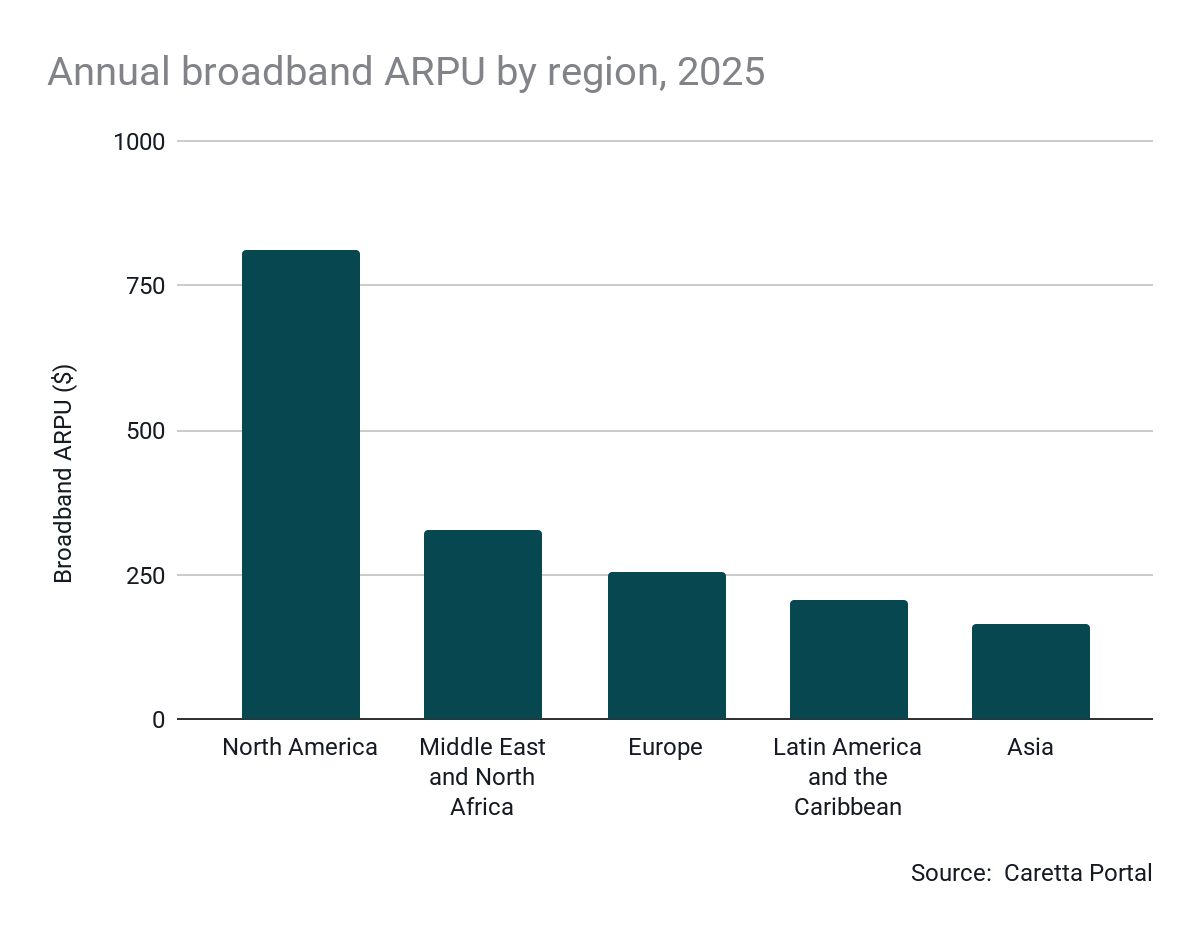
Heavy investment in next-generation access technologies has not persuaded consumers to pay more for faster speeds. To break through the price ceiling, operators must deliver value-led broadband services. This requires an increased focus on the home network (where customers actually experience their broadband) as a strategic asset in its own right. Focusing on this has greater potential to retain customers, win new ones, and increase ARPUs, as well as reducing costs through fewer hardware refreshes and unnecessary customer service calls.
Fibre, FWA and DOCSIS 4.0 can deliver broadband speeds well beyond what most households need. It’s a tough ask for consumers to spend more on something they don’t really use, but the connected home has become increasingly critical to everyday life, larger and more complicated. Making this work flawlessly and easy to manage is something that many do need.
Download the research here.
The primacy of software will only grow as operators look to AI to further enhance broadband and home networking services. AI will be useful for improving customers’ home network experiences through proactive remote maintenance, managing network traffic and Wi-Fi optimisation, as well as further reducing operational costs for operators.
Vendors are anticipating this and have begun including neural processing units (NPUs) in higher-end CPE designs for local edge AI processing, aiming to increase CPE unit prices by reducing AI latency, the cost of running AI in the cloud and customers’ data and privacy fears. As with new access and Wi-Fi technology, any price premiums for vendors for NPU integration will likely vanish quickly. It’s the AI functions that will offer longer-term value creation.
You can request the full analysis by filling out the form below. For more information on telecoms tech data, reach out directly at info@carettaresearch.com.
Blog post tags
Blog posts
Read more
September 25, 2026

September 2, 2026
July 21, 2026
