
Re-architecting sports media: how rights owners are adapting to a changing market

While total sports rights value reached an all-time high of $60B, overall global sports media growth is slowing significantly. Historical compound annual growth rates of 5.4% between 2018 and 2024 are projected to drop to just 2.2% between 2024 and 2030. High value traditional sports are experiencing lagging growth as rights prices rise faster than buyer revenues, creating a mathematically unsustainable model for traditional broadcasters.
Why traditional media rights models are slowing down
For decades, traditional linear networks and pay TV operators drove steady growth in sports media rights. However, rights prices have escalated to levels that many buyers can no longer support. As a result, several high profile rights holders and buyers have recently exited major deals:
- Amazon Prime stepped away from the English Premier League after packaging updates increased costs significantly.
- DAZN exited domestic rights arrangements in Ligue 1 and the Belgium Pro League due to unsustainable cost structures and rising piracy.
- FanDuel and Bally network collapsed in the US under the pressure of cord cutting, high costs, and declining ad revenue.
- WBD and TNT lost NBA rights after more than 30 years of broadcasting the league.
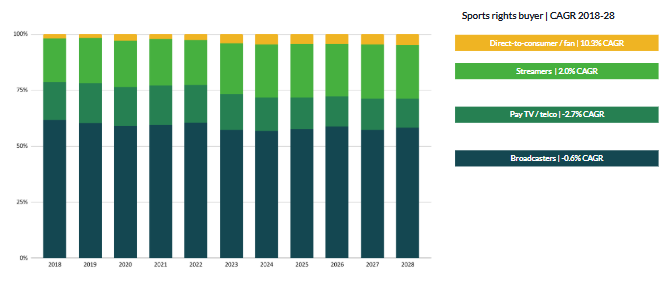
Traditional pay TV and telco rights spending is declining by 2.7% CAGR, while traditional broadcaster spending is declining by 0.6% CAGR. In contrast, pure streamers are growing at 2.0% CAGR, and direct to consumer (D2C) fan platforms are expanding rapidly at 10.3% CAGR.
The shift towards direct to consumer streaming
D2C and streaming strategies are no longer optional additions for sports organisations: they are essential survival mechanisms. To maximise acquisition, retention, and pricing control, leagues are increasingly taking ownership of their production and distribution chains.
For example, the English Premier League is moving to in-house production, stepping away from third-party production companies. By controlling the primary broadcast feed directly, leagues can manage global feeds, create dedicated D2C content streams, and deploy commercial virtual ad layers tailored to specific international markets.
Top sports organisations across Europe and Asia are already leveraging D2C models to gather valuable audience data and diversify their earnings. Short clips on social media, live fan engagement applications, and dedicated mobile video feeds are helping rights holders reach younger demographics who consume sports differently than previous generations.
D2C risks and the importance of balanced revenue streams
While D2C opens direct channels to fans, it is not without financial risk. The domestic French Ligue 1 deal collapsed after DAZN and the French league terminated their €400M per season agreement early. DAZN paid a €100M exit fee, leading the league to launch its own direct to consumer channel, Ligue 1+, priced at €14.99 per month.
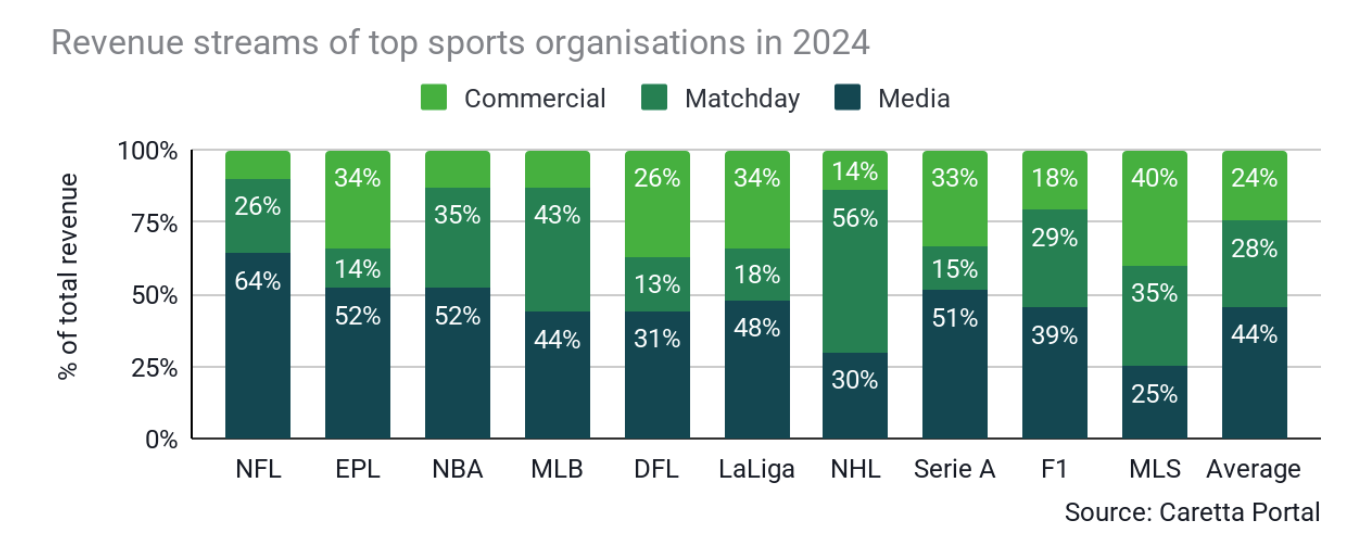
To mitigate risks, major sports organisations balance their revenue streams across multiple pillars. On average, leading sports entities derive 44% of their revenue from media rights, 28% from matchday operations, and 24% from commercial partnerships.
Practical strategies to re-architect revenue streams
To maintain healthy growth, rights holders and buyers are implementing innovative strategies across content, production, and venues:
- Monetising short-form and social content: reclaiming non-exclusive short clips and vertical video turns social media platforms from simple marketing channels into high-margin revenue products.
- Broadcaster diversity: splitting rights packages across multiple platforms and selling select matchday packages prevents reliance on a single broadcaster.
- Athlete-first storytelling: leveraging the global follower bases of individual athletes allows leagues to bridge engagement gaps through documentary-style and behind-the-scenes content.
- Cloud production: transitioning to cloud-based infrastructure using elastic OpEx model enables rapid setup times, remote production, lower carbon footprints, and infinite custom feeds (such as localised commentary or live betting overlays), as demonstrated by the NHL.
- Virtual advertising: virtual advertising technology enables tailored, region-specific sponsor overlays. Sponsorship revenue linked to virtual advertising has grown from $3B to $16B, supported by technical spending growth from $29M to $66M.
- Modern venue transformation: venues are evolving with 360-degree LED ribbons, transparent LED panels, IP-based media networks, and data-driven fan engagement tools to turn matchday attendance into interactive experiences.
Conclusion
Traditional media models can no longer support skyrocketing rights fees on their own. By re-architecting revenue streams through in-house production, cloud workflows, targeted virtual advertising, and robust D2C channels, sports organisations can build sustainable, future-proof business models.
For further insights and industry analysis, contact Caretta Research at info@carettaresearch.com.
Blog post tags
Blog posts
Read more
September 2, 2026

July 21, 2026
July 7, 2026
