
Trendspotting: sports content and distribution in 2026 and beyond

As the sports media landscape evolves rapidly, broadcasters, rights holders, and technology vendors face a transformative period. Following discussions at SVG Europe's FutureSPORT 2025, one message is clear: experimental technology trends must deliver immediate, measurable value. In an era dominated by budget pressures, technology implementations must serve a clear purpose – either saving money or driving fresh revenue.
While direct-to-consumer (DTC) online viewing has expanded the vendor ecosystem and brought sports onto more technological roadmaps, traditional operators and emerging streamers are navigating very different economic realities.
The broadcast vs streaming landscape: where is revenue growth headed?
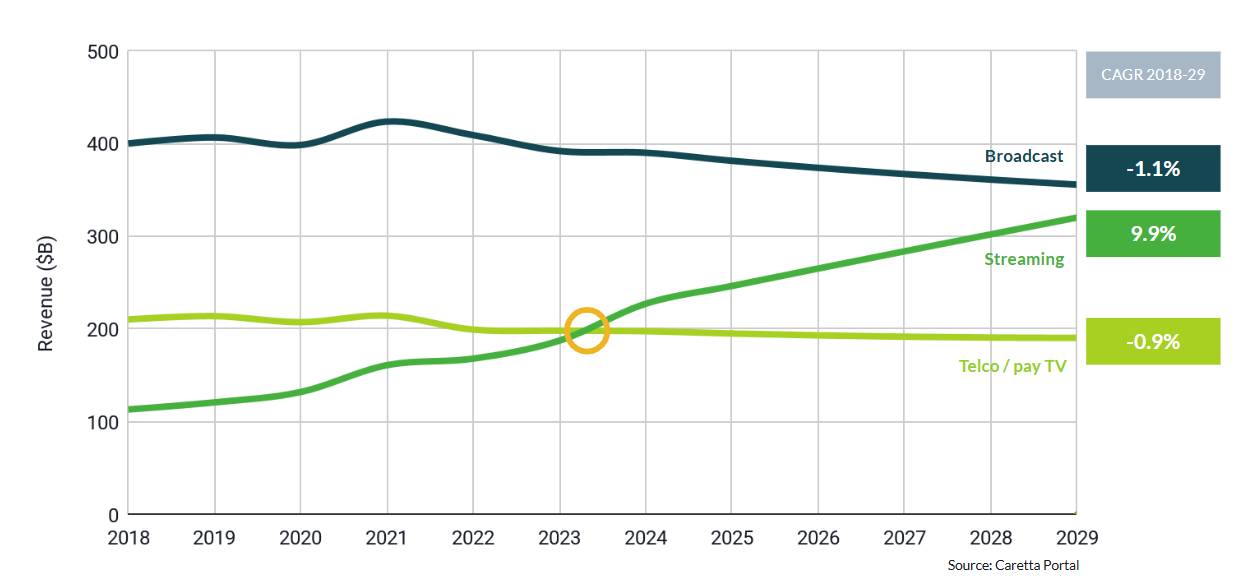
Traditional revenue models in sports broadcasting are undergoing a permanent realignment. Market data highlights a stark divergence across media channels through 2029:
- Streaming: Delivering strong growth with a 9.9% CAGR (2018–2029).
- Linear Broadcast: Experiencing a contraction of 0.9% CAGR.
- Telco and Pay TV: Facing a decline of 1.1% CAGR.
Crucially, streaming revenue expansion is not primarily benefiting traditional legacy broadcasters. While years of heavy capital expenditure into DTC platforms have established a "good enough" foundation, broadcasters are now flattening their streaming tech spend and refocusing investments on live production capabilities and OVP CMS infrastructure.
Live content: broadcasters' last stronghold under siege
Live sports and news remain the cornerstone of traditional broadcasting, generating the highest volume of annual production hours across the industry. However, even this protected domain is seeing intense competition as premium sports rights systematically migrate towards digital-first streaming platforms.
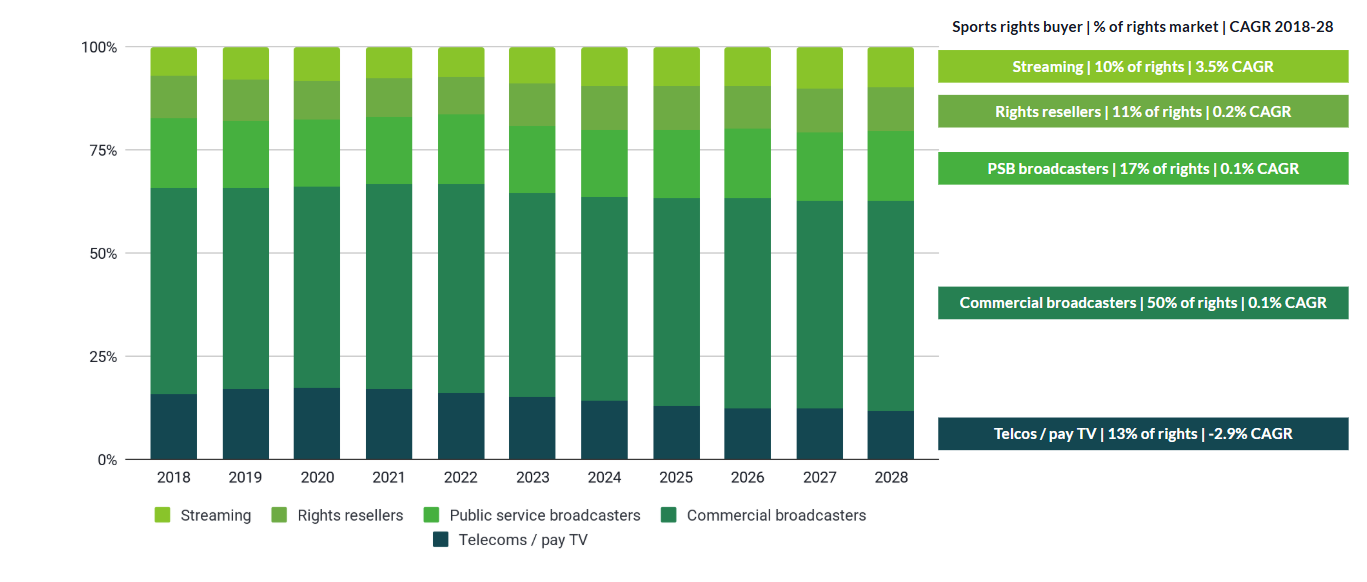
Market share figures reflect this ongoing transition in rights acquisition:
- Commercial broadcasters: Control 50% of the rights market, but with flat growth (0.1% CAGR).
- Public service broadcasters (PSBs): Hold 17% of rights, also stagnant at 0.1% CAGR.
- Telcos and pay TV: Hold 13% of rights, contracting at 2.9% CAGR.
- Rights resellers: Hold 11% of rights, showing minimal growth (0.2% CAGR).
- Streaming platforms: Currently command 10% of rights, but are growing rapidly at a 3.5% CAGR.
The UK's key role in the European sports rights ecosystem
On the global stage, Europe and the United States remain the premier regional markets by sports rights spend. Within Europe, the United Kingdom stands as the largest buyer of rights deals by total value, making it a central testing ground for new distribution models.
Major streaming platforms and global tech giants are aggressively securing tier-1 live properties:
- Global streaming leaders: platforms like Netflix, Amazon Prime, and Apple TV+ are capturing flagship events ranging from the NFL, MLB, and F1 to high-profile sports entertainment such as WWE.
- International tournaments: key properties including the FIFA World Cup 2026 and major domestic football leagues are increasingly finding homes on digital services.
- Specialist streamers: tier-1 and niche sports properties - such as French Pro D2 Rugby and regional domestic football - are establishing strong digital footprints.
Next-generation tech: protecting experiences and prioritising engagement
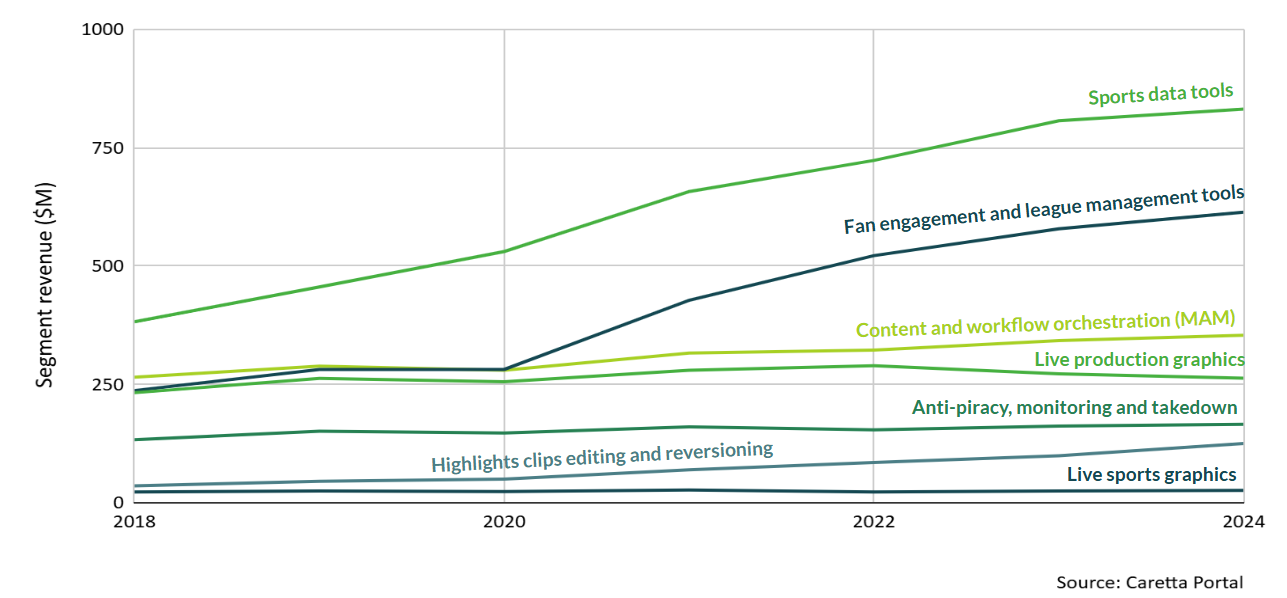
To remain competitive, rights holders and broadcasters must invest strategically in tools that deepen fan engagement while enhancing operational efficiency. Key areas of technological focus include:
- AI-powered media asset management (MAM): platforms such as Quickplay AI Studio allow automated clipping and rapid reversioning of traditional 16:9 streams into vertical 9:16 content suitable for mobile-first audiences.
- Advanced fan engagement and data tools: incorporating interactive sports data feeds, real-time analytics, and league management software to personalise the viewing experience.
- Enhanced live graphics: deploying real-time graphics engines to enrich live narrative delivery.
- Anti-piracy and content protection: robust monitoring and rapid takedown solutions to protect high-value live streams.
- Immersive venue convergence: pioneering projects (such as Cosm and Epic Games integrations) unite physical crowds, virtual spaces, and real-time live video streams to create shared location-based entertainment.
Strategic partnerships: co-branded platforms and youth engagement
Maximising rights value requires strategic multi-platform collaborations aimed at acquiring first-party data and diversifying revenue streams. Innovative models gaining traction include:
- Alternative content formats: tailored broadcast experiments, such as La Liga's partnership with Mediapro and GOL to air matches natively on TikTok, or youth-focused live broadcasts like the NFL on Nickelodeon.
- Co-branded DTC services: strategic joint ventures between federations and broadcasters, such as DAZN collaborating with FIFA to relaunch the FIFA+ direct-to-consumer platform for live and on-demand content.
- Behind-the-scenes storytelling: documentary series and non-match content that build narrative momentum and nurture year-round fan connection.
Strategic summary and key takeaways
- Drive operational efficiency: budget restrictions mean technology deployments must deliver concrete financial return, either by reducing production costs or opening new monetisation channels.
- Prioritise fan engagement tech: with live rights spend becoming increasingly competitive, investing in interactive, data-rich viewing experiences is vital to retain audience attention.
- Embrace collaborative distribution: broadcasters and rights holders should leverage co-branded platforms, vertical video formats, and targeted partnerships to reach younger demographics effectively.
For further insights and industry analysis, contact Caretta Research at info@carettaresearch.com.
Blog post tags
Blog posts
Read more
September 2, 2026

July 21, 2026
July 7, 2026
