
FIFA World Cup: $8.9B record revenue masks 19% per-game rights value fall and 11% broadcast deal volume drop

Caretta Research forecasts a record $8.9B in total revenue for the 2026 World Cup, representing a 54% uplift over the 2022 tournament. This growth is predominantly driven by the rise in commercial and matchday revenues, with sports rights sold to media also contributing.
The key driver behind the jump from $5.8B to $8.9B is FIFA’s decision to expand the tournament from 32 to 48 teams, which triggered a 47% growth in match inventory, rising from 64 matches in 2022 to 104 matches in 2026.
The inclusion of 40 additional matches has bolstered FIFA's financial results by providing more content to sell and greater utilisation of stadium assets. Matchday revenue is the fastest-growing segment, forecast to grow 220% from 2022, a result of both increased ticket volume and rising prices across ticketing and hospitality offerings.
Commercial revenue, which includes traditional advertising and new placements such as cooling breaks and the expanded 11-minute half-time Super Bowl-style show, which will extend half-time to 25-30 minutes at the final, is forecast to rise by nearly $300M, an 18% jump from 2022.
While revenue from sports rights sold to media organisations is forecast to increase by $1B (+32% from 2022), its overall share of total revenue will be reduced, falling below the 50% threshold for the first time since at least 1998, when the tournament format changed to include 32 teams. As a direct result of the 47% expansion in the number of matches to be broadcast, the rights value per game has decreased by 19%.
Regional time zone differences drive contrasting broadcast deal trends
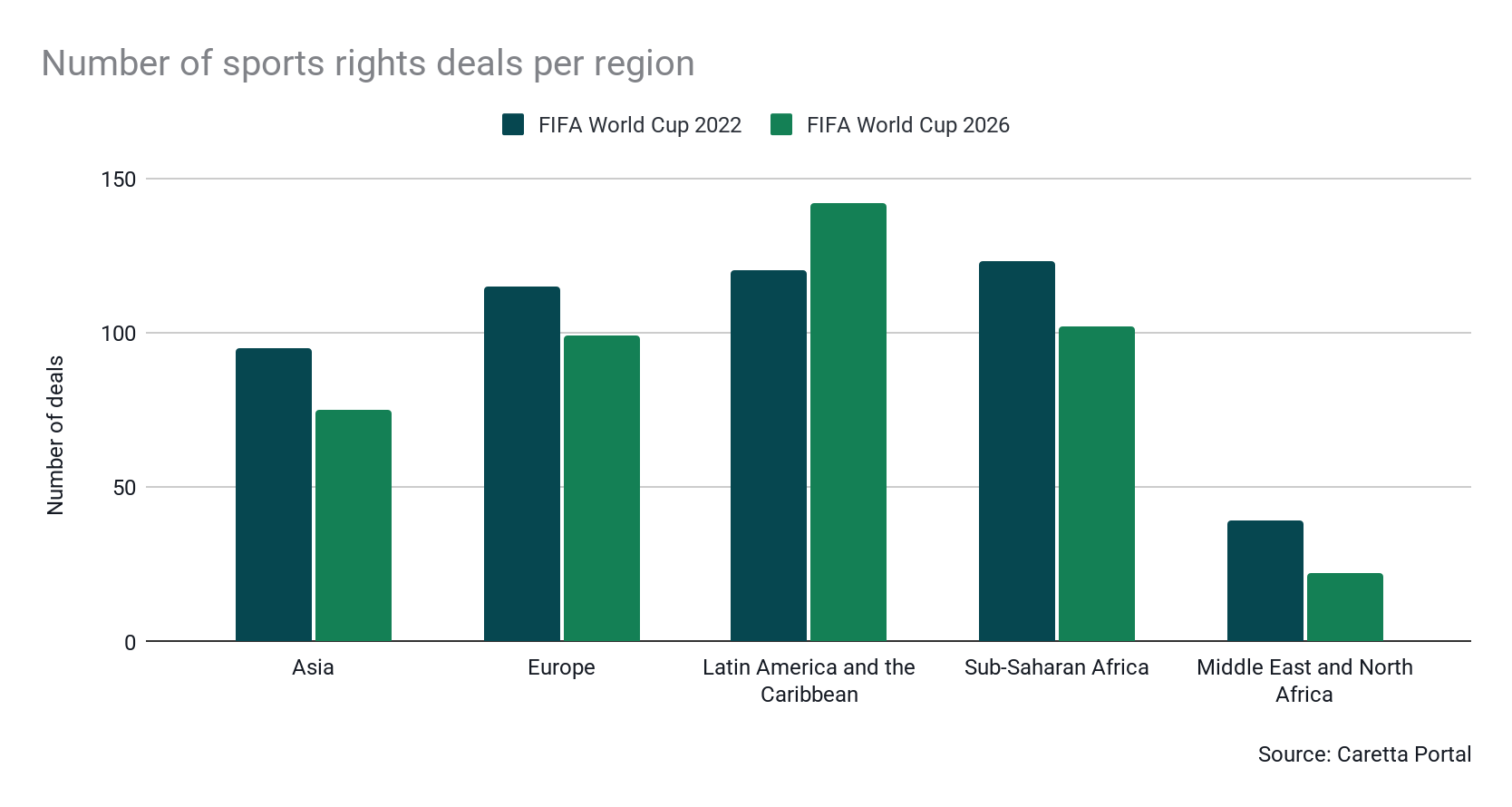
The primary factor contributing to this reduction in sports rights deal volume is the North American time zone, which presents a significant difficulty for international media. The total volume of global broadcast deals has dropped by 11%, falling from 495 in 2022 to 443 in 2026. When contrasted with the overall rise in sports rights revenue, this drop highlights FIFA's shift towards fewer broadcast partnerships with substantially higher individual values.
For prime audiences in Europe and Asia, many live matches fall in the middle of the night. Because overnight audiences generate less traditional TV advertising revenue, secondary broadcasters and sub-licensers have stepped away from the market entirely.
In Asia, the total number of broadcast deals fell by 21%, mainly because regional partnership agreements plummeted from 60 down to 24. This forced a move towards local networks to ensure matches could still be shown, which pushed the number of single-country buyers up from 35 to 51. However, the lack of competition meant FIFA had to accept much lower fees to avoid broadcast blackouts, most notably with the deal for China’s CCTV, which dropped from $250M to $60M.
The media landscape is vastly different in regions with time zones more closely aligned with North America. In Latin America and the Caribbean, where match times are ideal for viewers, the total number of broadcast deals rose by 18%. This was boosted by an 80% increase in teams from the region, with the number of participating nations rising from 5 to 9. Instead of leaving a single network to cover the cost of showing the tournament individually, regional networks and streaming platforms are increasingly collaborating to share the burden. This led to a 22% increase in partnerships across multiple territories, ensuring the matches were broadcast live during peak viewing times.
Detailed sports data now available in Caretta Portal
"Even though FIFA is set for record-breaking total revenue in 2026, the international broadcast landscape is becoming increasingly difficult. Media rights now represent a smaller portion of the overall revenue pie, with the value of each individual match dropping by 19%", says Evangelos Vrysellas, research analyst at Caretta Research. "The combination of middle-of-the-night kick-offs for major global markets and rising production expenses has discouraged many potential bidders, leading to a 11% drop in the total number of broadcast deals”.
Through Caretta Portal, Caretta Research provides the expert research and proprietary analysis that rights owners, buyers, and technology vendors need to make confident, data-backed decisions. By focusing on where sports rights, media buyers, and technology meet, Caretta Research helps clients drive commercial results through actionable intelligence and granular transparency into the global sports landscape.
Blog post tags
Blog posts
Read more
October 20, 2026

October 13, 2026
September 25, 2026
