
Five key trends to watch at the NAB Show 2026

The NAB Show 2026 will unveil a media industry defined by dual-speed transformation: massive consolidation at the top driven by macroeconomic pressures, countered by a “long-tail” revolution fueled by the practical, “coming-of-age” integration of agentic AI. Here are the five critical themes that will shape the conversations and the future of the sector.
The coming of age of generative AI
Generative AI is transitioning from a period of intense hype to a phase of practical integration, with 2026 marked as a "coming of age" for the technology.
Adoption is shifting from experimental play to the deployment of tools that solve specific technical challenges and reduce content production costs. While initial concerns focused on the potential for "AI slop" (low-quality, repetitive, or derivative AI-generated content), the trend is now defined by human-centric applications where AI augments professional storytelling and cinematography. For media companies to compete effectively in this new landscape, they must embrace gen AI to achieve material efficiencies and enhance audience value.
The rise of agentic AI further signals a move toward more sophisticated, "AI-native" operations. The transition from "GenAI as a tool" to "GenAI as an agent" is re-architecting the media landscape, moving beyond simple prompts toward autonomous operations that manage complex content lifecycles:
- Autonomous reel ecosystems in sports: AI agents are shifting from manual editing to an operational mandate, automating highlight detection and instant distribution to meet the 24/7 demand of digital ecosystems. Systems can now autonomously generate localised, player-centric reels and "smart" highlights to engage fans who increasingly favour non-live content.
- Dynamic creative and monetisation in advertising: Sponsorship is evolving into an immersive storytelling platform. AI agents co-create highly targeted creative copy and campaigns, while autonomous virtual advertising overlays transform physical stadium boards into geo-targeted digital inventory, significantly scaling global revenue opportunities.
- Narrative reconstruction in production: in high-end video production, agentic AI serves as infrastructure for visual transformation. Technologies like autonomous de-aging and face swapping allow filmmakers to recreate historical scenes with precision, while AI-driven digital avatars and virtual characters enhance storytelling without traditional production overhead.
Macroeconomic impacts and recession
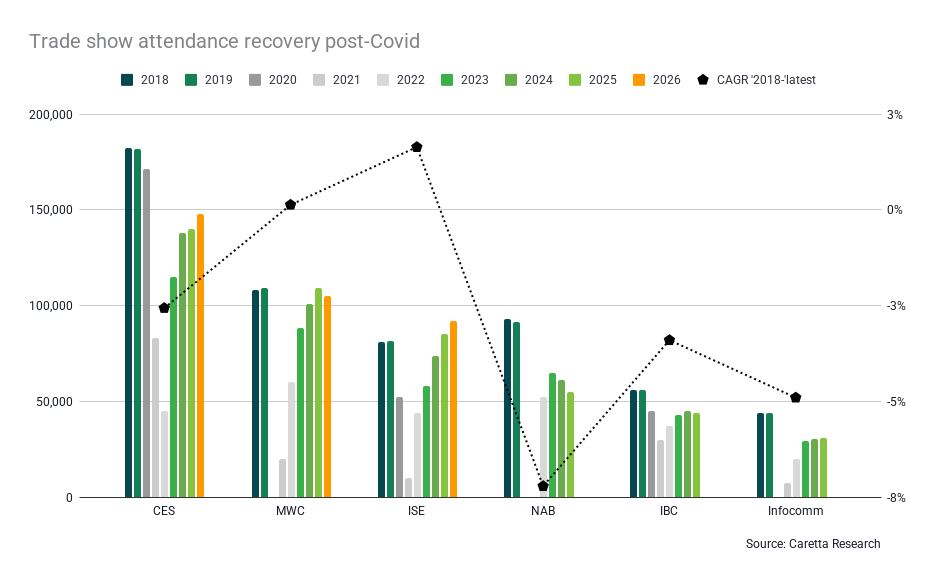
The global macroeconomic situation is predicted to significantly impact the industry. The war and resulting oil price shock are creating pressures highly suggestive of another recession. Historically, such downturns directly affect the advertising market and subsequently media revenues, a pattern evident in 2008. The key question now is whether the current situation will similarly affect attendance or business at this year's NAB Show.
Consolidation at the top and the long-tail revolution
Established media players are focused on getting bigger and through major mergers and acquisitions (M&A). This signals a massive consolidation at the larger, traditional end of the market. Examples of this trend include the merging of Warner Bros. Discovery and Paramount and the merging of Banijay and All3 Media.
In stark contrast to this consolidation, a new market segment is growing rapidly at the "long tail". This long tail is driven by new content creators, the pro AV market, and includes areas such as sports-related content. This segment represents thousands of small organisations opening up, creating a market that must now be viewed as having consolidation at one end and the long tail at the other.
The creator economy as a strategic imperative
The creator economy has emerged as a fundamental shift in content production and distribution. For traditional broadcasters, this represents both a challenge and a massive opportunity:
- Strategic investment: broadcasters are now investing directly in creator-led content and platforms like youtube to reach new demographics and next-generation consumers.
- Hybrid platform models: several large creator companies, such as nebula and dropout, are using youtube as a "top-of-funnel" discovery engine while hosting premium, high-production content on their own D2C apps.
Competing in the new market landscape
The new market structure necessitates a complete shift in competitive strategy for both vendors and buyers.
- For vendors: for vendors, success requires moving away from manual tagging and slow, siloed workflows toward AI-native infrastructure that can react to trends at the speed of culture. Traditionally geared towards selling to a few hundred large broadcasters, vendors now need new mechanisms to sell to thousands of small organisations, such as creators and pro AV.
- For buyers: Companies must focus their efforts and diversify to compete with YouTube, particularly in high-value areas like sports rights. An example of this adaptation is Sky’s deployment of a cloud master control room (MCR), which allows them to affordably produce and deliver unlimited numbers of sports events as D2C streams, even those with low rights costs.
These five themes, spanning economic reality, market structure, and technological disruption, are set to be the primary drivers of discussion at the NAB Show 2026. Understanding how these forces interact is crucial for navigating the evolving media landscape. The ability to embrace new operational models, particularly taking advantage of the “coming of age” of generative AI, will separate the competitors from the market leaders.
The Caretta Research team will be at the NAB 2026 show floor, if you want to discuss all the latest trends, book a meeting here, or submit the form below and we'll contact you as soon as possible. For more insights into the media tech industry contact us at info@carettaresearch.com.
Blog post tags
Blog posts
Read more
September 25, 2026

September 2, 2026
July 21, 2026
