
Network X 2026: why telecoms investment is shifting towards service value

Faster broadband alone is becoming a harder way for operators to stand out. Discussions at Network X 2026 pointed to a more practical priority: making existing networks work better, reducing operating costs and improving the experience subscribers actually notice.
Our team at Caretta Research identified six connected themes, from practical AI and home-network management to fibre investment. The strongest commercial opportunities may come from making infrastructure more reliable and easier to operate, rather than adding capacity alone.
Download the full post-Network X report.
AI is being judged by operational results
The conversation around artificial intelligence is moving towards specific applications. Fault detection, predictive maintenance and network optimisation are gaining attention because they address immediate operational problems.
Fully autonomous networks remain a longer-term ambition, with fragmented systems and integration challenges limiting how quickly operators can get there. For suppliers, demonstrable improvements in efficiency, assurance and support costs are likely to be more persuasive than broad promises of autonomy.
Beyond connectivity, but with investment risks
Sovereign AI is opening up potential roles for telecoms operators in enterprise AI and cloud services. Existing infrastructure and customer relationships give operators a starting point, while partnerships can help them avoid building the entire technology stack themselves.
The economics are less straightforward. Computing infrastructure requires significant capital, power and cooling, and demand remains uncertain. Operators need a clear view of where they can add value without taking on disproportionate investment risk.
Download the full post-Network X report.
The home experience becomes a competitive priority
For many households, broadband speed is no longer the main source of dissatisfaction. Reliability, Wi-Fi performance and the ability to resolve problems quickly are becoming more important.
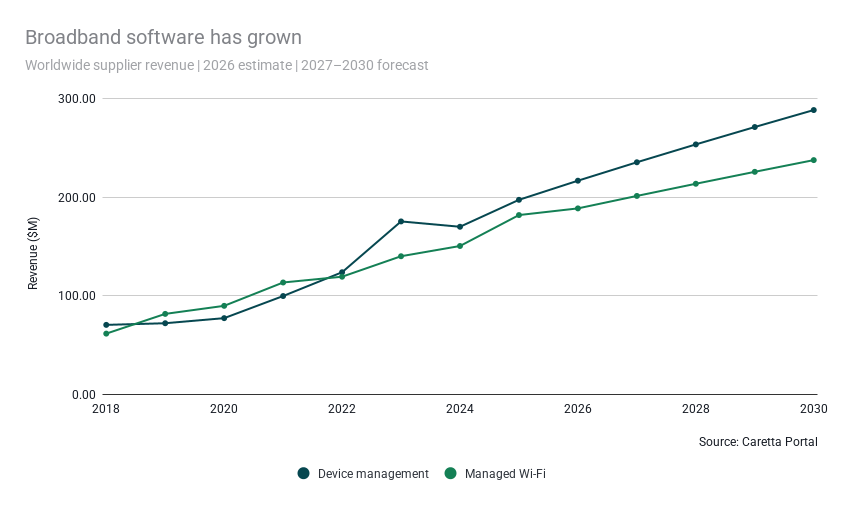
This is directing attention towards device management, managed Wi-Fi and self-care tools. Remote diagnostics and proactive troubleshooting can help operators resolve issues earlier and reduce unnecessary support visits. Our analysis also shows sustained growth in spending on these software categories.
Security is moving into network management
Cybersecurity is increasingly part of the managed home-network proposition. Network-level protection and proactive vulnerability management can reduce operational risk while giving operators more control over connected devices.
Yet the commercial challenge remains: customers may expect basic protection to be included in broadband, making standalone security subscriptions harder to sell. Integrating security into the wider service experience may offer a clearer operational rationale.
Download the full post-Network X report.
Fibre grows as operators look to extend hardware lifecycles
Fibre access equipment is attracting investment as legacy DSL and cable categories decline. At the same time, rising hardware costs are encouraging operators to make equipment last longer and improve performance through software.
That creates a dual priority for suppliers: supporting new fibre deployments while helping operators get more from devices already in the field.
What this means for telecoms tech suppliers
Across these discussions, the common theme is measurable value. Operators are looking for technologies that improve network performance, lower support costs or strengthen the subscriber experience.
Suppliers able to connect their offerings to those outcomes have a clearer proposition than those selling features in isolation.
Download the full post-Network X report below, to explore all critical insights in more detail.
To learn more about our telecoms tech data and insights at Caretta Research, contact us at info@carettaresearch.com.
Blog post tags
Blog posts
Read more
October 20, 2026

October 13, 2026
September 25, 2026
